

Inductive Proximity Sensor and Switch
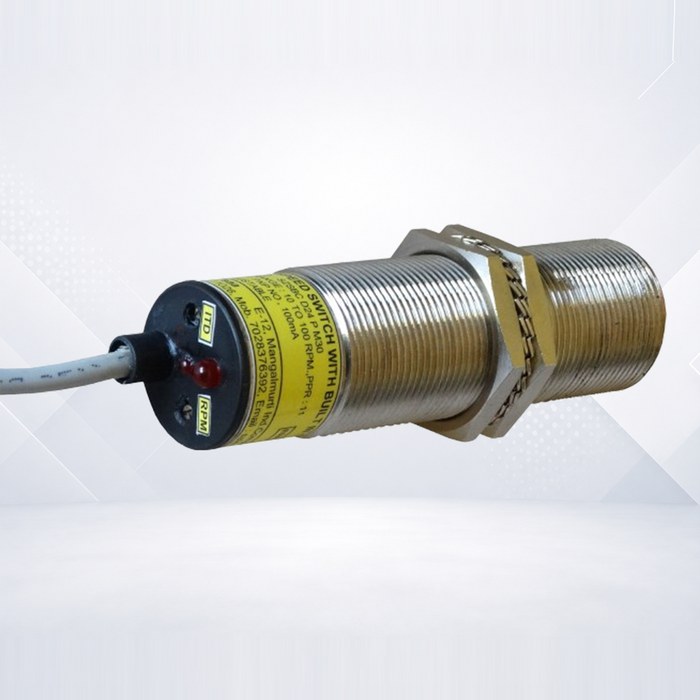


Smartsaa Instrument Pvt Ltd is leading Inductive Proximity Sensor and Switch Manufacturers, Suppliers, Dealers, Traders and Exporters in India. An inductive proximity sensor and switch is a non-contact sensing device used to detect metallic objects in industrial automation and control systems. It is widely used for position detection, counting, machine monitoring, and object presence detection without requiring physical contact with the target.
An inductive proximity sensor works by generating an electromagnetic field around its sensing face. When a metal object enters the detection area, it disturbs this field, and the internal electronic circuit detects the change and produces a switching signal.
We offer inductive proximity sensors and switches in different configurations to meet varied industrial requirements. With options such as NPN and PNP outputs, NO and NC functions, and 2-wire, 3-wire, and 4-wire connections, these sensors can be integrated into a wide range of automation systems.
As we are leading Inductive Proximity Sensor and Switch Manufacturers in India, our Types are designed to meet different application requirements and industry standards, including the following types:
As a trusted Inductive Proximity Sensor and Switch Suppliers in India, we serve businesses across various industries that meet professional visual communication requirements.
| Parameter | Specification | Available Options | Application Consideration | Remarks |
|---|---|---|---|---|
| Sensor Technology | Inductive | Shielded / Unshielded | Metallic object detection | Non-contact sensing |
| Target Material | Metal | Ferrous / Compatible Metals | Object and position detection | Material affects sensing distance |
| Output Configuration | Switching Output | NPN / PNP | PLC and control systems | Select according to controller |
| Switching Function | Digital | NO / NC | Machine control | Model dependent |
| Wiring Configuration | Electrical Connection | 2-Wire / 3-Wire / 4-Wire | Installation requirements | Follow model-specific wiring |
| Detection Range | Model Dependent | Multiple Sensing Ranges | Position and presence detection | Depends on target and sensor design |
| Supply Voltage | Model Dependent | DC Options | Industrial automation | Verify before installation |
| Protection Rating | Model Dependent | Industrial Enclosure Options | Dust and moisture exposure | Select according to environment |
As Inductive Proximity Sensor and Switch Dealers in India, our products provide several Features and Benefits including consistent quality, smooth finish, and long service life.
| Features | Benefits |
|---|---|
| Non-contact sensing | Detects metallic objects without physical contact, reducing mechanical wear. |
| Reliable metal detection | Provides consistent detection of suitable metallic targets in automation applications. |
| NPN and PNP outputs | Allows selection according to the input configuration of the connected control system. |
| NO and NC options | Provides flexibility for different machine control and switching requirements. |
| 2-wire, 3-wire and 4-wire options | Supports different wiring arrangements and system integration requirements. |
| Multiple detection ranges | Helps users select a suitable sensor according to the required sensing distance. |
| Compact construction | Makes installation practical in machines and areas with limited available space. |
| Fast switching response | Supports counting, positioning, and automated machine operations. |
| Easy PLC integration | Allows connection with PLCs, controllers, counters, and other automation equipment. |
| Industrial suitability | Supports dependable operation in manufacturing and industrial automation environments. |
As Inductive Proximity Sensor and Switch Traders in India, our all types are used in various types of industrial sectors such as:
As one of the leading Inductive Proximity Sensor and Switch Exporters in India, we deliver premium-quality solutions designed to meet diverse industrial requirements. Here's why we stand out:
Smartsaa Instrument Pvt Ltd is leading Inductive Proximity Sensor and Switch Manufacturers, Suppliers, Dealers, Traders and Exporters in India. An inductive proximity sensor and switch provides a dependable method of detecting metallic objects without physical contact. Its electromagnetic sensing technology makes it suitable for position detection, counting, machine monitoring, metal detection, and automated control applications. With NPN and PNP outputs, NO and NC functions, and 2-wire, 3-wire, and 4-wire configurations, these sensors can meet different industrial integration requirements. We provide suitable solutions for automation systems while assisting customers with product selection, installation, wiring, and application requirements.
An inductive proximity sensor is a non-contact device that detects metallic objects by sensing changes in an electromagnetic field generated near its sensing face.
The sensor generates an electromagnetic field. When a metallic object enters its sensing range, it changes the field through eddy-current effects, causing the internal circuit to switch the output.
NPN and PNP sensors have different transistor output configurations. The appropriate type depends on the input and wiring requirements of the PLC or control system being used.
Wiring depends on whether the sensor is a 2-wire, 3-wire, or 4-wire model and whether it uses an NPN or PNP output. The manufacturer's wiring diagram should always be followed during installation.
Check the power supply, wiring connections, sensing distance, target material, sensor alignment, output configuration, and PLC input. These checks can help identify common detection and switching problems.

